
The Easy Key Mini
A Simple Visual Tool That Makes Music Theory Easy

For as long as I can remember, I’ve loved music.
Music came naturally to me. Music theory did not.
As a teenager, I found music theory incredibly frustrating. Not because the concepts were difficult, but because there seemed to be so much memorisation involved.
Every key signature had its own collection of sharps and flats.
Every scale seemed to require another list to memorise.
Every chord formula felt like another piece of information that needed to be stored somewhere in my already overloaded brain.
Over time I realised something important:
Music isn’t really about letters.
Music is about relationships.
The note names may change from key to key, but the relationships remain exactly the same.
A major scale is always:
1 2 3 4 5 6 7
Whether you’re playing in C Major, G Major, F Major, D♭ Major, or any other key, those relationships never change.
Yet most students are taught music almost entirely through the alphabetical system.
When you look at all the major key signatures side by side, it can feel overwhelming.
Get Started
If you’d like to try the Easy Key Mini for yourself, here are a few helpful resources:
Download the Easy Key Mini
https://matcreedon.gumroad.com/l/easy-key-mini
Build Your Own Easy Key Mini (DIY Video Tutorial)
Join the Mat Creedon School of Music
https://www.skool.com/mat-creedon-school-of-music-4248
The Easy Key Mini is available as a free download, and the tutorial will guide you through printing, cutting, and assembling your own copy.
The Problem With Traditional Music Theory
Consider the following:
C Major:
C D E F G A B
G Major:
G A B C D E F#
D Major:
D E F# G A B C#
A Major:
A B C# D E F# G#
And so on through every key.
It’s no wonder so many students believe music theory is difficult.
The challenge isn’t the theory itself.
The challenge is seeing the pattern.
When I was younger, I spent countless hours trying to memorise key signatures, scales, and chord spellings.
The amount of information felt enormous.
The reality is that the pattern never changes.
What changes are the note names.
The numbers stay the same.
The Original Easy Key
A few years ago, I began experimenting with a simple teaching aid that eventually became known as the Easy Key.
The original Easy Key used a sliding mechanism that allowed students to quickly see how numbers related to note names.
The response was immediate.
When I shared it on social media, musicians instantly understood what it was trying to do.
The challenge was that it still had limitations.
It was a more involved DIY build.
It focused primarily on a single key at a time.
And I felt there had to be a simpler, more flexible solution.
Something modular.
Something expandable.
Something that could grow alongside the musician.
Enter The Easy Key Mini
The Easy Key Mini was born from a simple question:
“What if the tool became smaller, simpler, and more useful?”
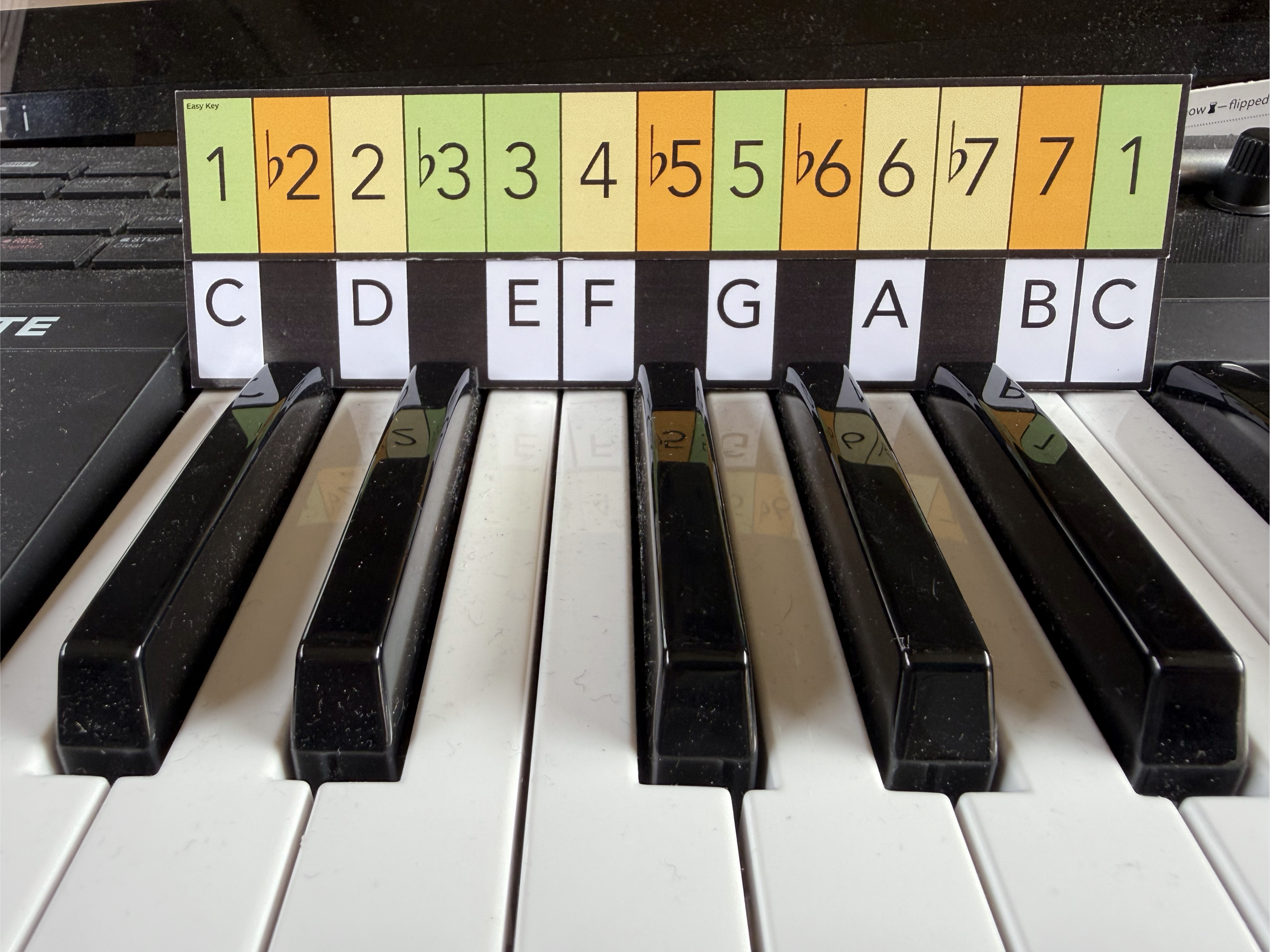
Instead of a larger sliding device, the Easy Key Mini is a slimline modular strip that sits directly above the keyboard.
Multiple Easy Key Minis can be placed side by side across an entire piano.
Rather than viewing only one key signature, you can compare multiple key signatures simultaneously.
This was one of the breakthroughs.
For the first time, students could see the relationship between multiple key signatures at the same time.
The result is a surprisingly powerful visual reference system.
See the Easy Key in Action
What Can You Learn With It?
The short answer?
Almost anything.
The Easy Key Mini allows musicians to quickly visualise:
Major scales
Natural minor scales
Harmonic minor scales
Melodic minor scales
Chromatic scales
Pentatonic scales
Major blues scales
Minor blues scales
Modes
World music scales
Major chords
Minor chords
Diminished chords
Augmented chords
Seventh chords
Ninth chords
Eleventh chords
Thirteenth chords
Upper extensions
Chord progressions
Nashville Number System concepts
Transposition between keys
Because the numbers remain constant, musicians begin to see music as a collection of patterns rather than isolated facts.
Once you understand the pattern, the need for memorisation decreases dramatically.
More Than A Music Tool
One of the things I love about the Easy Key Mini is that it isn’t just a music theory device.
It’s also:
A bookmark
A fridge magnet
A teaching aid
A songwriting tool
A composition tool
A music production reference
A classroom resource
It’s small enough to keep nearby and useful enough that you’ll probably reach for it every day.
I wanted something musicians could throw in a bag, leave on a piano, stick to a fridge, or use as a bookmark in a music book.
Something affordable.
Something practical.
Something that solved a real problem.
Why I Created It
My goal has never been to make music theory more complicated.
My goal has always been to make it easier.
I wanted something that instantly answered questions like:
What notes belong in this key?
What chord am I playing?
How do I transpose this progression?
What scale should I use here?
What is the 6 chord in this key?
What are the notes of a harmonic minor scale?
How do modes relate to the major scale?
Instead of searching through books or trying to remember dozens of separate rules, the answer is right in front of you.
A simple visual cue.
No guesswork.
No stress.
Just music.
Who Is It For?
The Easy Key Mini is useful for:
Piano students
Music teachers
Songwriters
Composers
Producers
Music enthusiasts
Beginners
Advanced musicians
If you work with music and find it difficult to remember the music theory basics, this device has you covered.
What’s Next?
Over the coming weeks I’ll be sharing more lessons, demonstrations, and tutorials showing how I use the Easy Key Mini in real-world situations.
We’ll explore:
Piano
Songwriting
Composition
Music Production
Ear Training
Improvisation
Chord Progressions
Transposition
Teaching Methods
Whether you’re a beginner, a music enthusiast, a teacher, a songwriter, or a producer, my hope is that the Easy Key Mini helps make music theory feel less intimidating and more enjoyable.
Because music theory was never meant to be a barrier.
It’s meant to be a bridge.
And sometimes all it takes is a simple visual reminder to help us see what was there all along.
Learn More
Download The Easy Key Mini
https://matcreedon.gumroad.com/l/easy-key-mini
Watch The DIY Build Tutorial
Join The Mat Creedon School of Music
https://www.skool.com/mat-creedon-school-of-music-4248
The Easy Key Mini is just one part of the wider Mat Creedon Music Method, a practical approach to understanding music through patterns, relationships, creativity, and real-world application.
I look forward to sharing more with you soon.
— Mat Creedon